Small Country, Higher Value: Timor-Leste’s Opportunity Inside ASEAN
Timor-Leste can leverage its ASEAN membership and economic partnerships—such as with New Zealand—by shifting its focus from volume to value, specializing in distinctive, high-quality exports like specialty coffee and turmeric to capture greater economic returns.
Timor-Leste does not need to compete with the largest economies in ASEAN on volume. Its opportunity may be to produce less, better — and capture considerably more value from what it produces.
When I visited Dili in August, I brought home two things that have stayed in my mind.
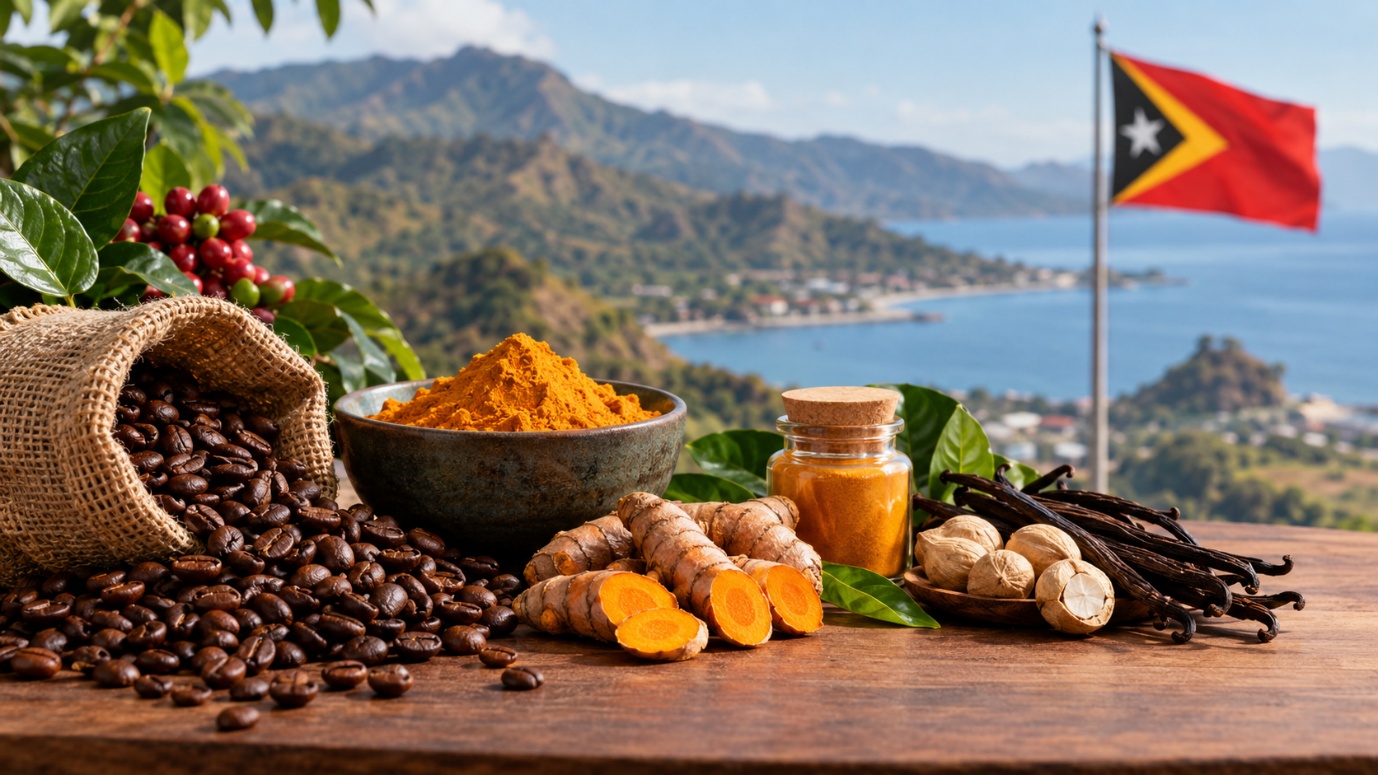
One was Timorese coffee. The quality was excellent and the aroma was quite distinctive.
The other was locally produced turmeric. I bought some and continue to use it today.
These are small things. But they raise a much larger economic question.
What can Timor-Leste produce that people outside Timor-Leste will willingly pay more for?
That question becomes particularly important now.
Timor-Leste is the newest member of ASEAN. It has also expressed its intention to assume the ASEAN Chairmanship in 2029.
The years between now and then present an opportunity not simply to prepare for an important diplomatic responsibility, but to think seriously about the type of economy Timor-Leste wants to build inside ASEAN.
And that economy does not necessarily have to look like anyone else’s.
Smallness can be an advantage
There is sometimes an assumption that developing economies must follow a familiar path: industrialise, manufacture at scale, compete on labour costs and progressively move up the economic ladder.
That model has worked extraordinarily well for some countries.
It does not follow that Timor-Leste should attempt to replicate it.
Timor-Leste has a population of around 1.4 million people. It cannot realistically compete with the scale of production available to the largest ASEAN economies.
But perhaps that is the wrong competition.
A small country does not necessarily need to produce the most.
It needs to ask whether it can produce something distinctive enough, good enough and scarce enough that the market will pay more for it.
That is a very different economic proposition.
It means moving from volume to value.
Coffee shows what is possible
Coffee is the obvious place to begin.
Timor-Leste already has international recognition for Arabica coffee grown in its highlands, and coffee remains overwhelmingly its most important non-oil export.
The ambition should not simply be to grow more coffee.
It should also be to capture more of the value attached to the coffee that is already grown.
That means improving quality consistently, grading, certification, processing, traceability, packaging, branding and direct relationships with specialty buyers.
The World Bank has previously noted that Timor-Leste is not a major coffee producer and therefore has good reason to specialise in specialty and niche varieties. The country’s National Coffee Sector Development Plan has targeted a substantial increase in the proportion of premium and specialty-grade coffee.
The obstacle is not the absence of a good product. Among the constraints identified have been low yields, inconsistent quality, limited certification, infrastructure and insufficient national quality standards.
Those are problems that can be solved.
And solving them changes the economics.
A kilogram of agricultural produce sold as an undifferentiated commodity is one thing.
A traceable, certified, beautifully packaged premium product with a recognised origin is something else entirely.
Turmeric may tell a similar story
The turmeric I brought back from Dili interested me for the same reason.
Timor-Leste has naturally occurring turmeric, including significant stocks reported in Baucau. Earlier analysis of the country’s spice value chain found that testing of the local variety showed more than acceptable curcumin content and identified the possibility of producing turmeric commercially.
But having an excellent agricultural product and having an internationally successful premium product are two different things.
Between the farm and the consumer sit testing, consistency, food-safety standards, organic certification, processing, packaging, branding, distribution and market access.
That gap is precisely where economic value is either captured or lost.
Imagine Timorese turmeric not simply leaving the country as another agricultural commodity, but reaching Auckland, Singapore, Tokyo or Melbourne as a tested, certified and traceable premium product carrying Timor-Leste’s name.
That is the difference between exporting a crop and building an industry.
What are the next five?
Coffee and turmeric make me wonder what else is there.
The answer deserves systematic investigation.
There are at least several candidates.
Specialty coffee is already established and has the clearest pathway.
Turmeric and premium spices deserve further development, particularly where distinctive characteristics can be scientifically established and marketed.
Vanilla is especially interesting. World Bank analysis has identified it among products in which Timor-Leste has demonstrated comparative advantage.
Coconut and candlenut products offer another possibility. Timorese businesses have previously exported organic candlenut oil internationally, demonstrating that value-added processing is possible.
And then there is the sea.
Timor-Leste has a long coastline and substantial marine resources. Seaweed and selected sustainable marine products warrant serious examination as higher-value export industries. World Bank analysis has also identified seaweed among areas of comparative advantage.
I would not pretend that all five will become major export industries.
Some may not.
That is precisely why the work needs to be done.
Identify the products. Test them scientifically. Determine their quality. Establish the potential markets. Find the impediments. Work with producers. Bring in international expertise where it is useful. Then concentrate resources on those with genuine commercial potential.
New Zealand understands this model
This is where I believe there is an interesting connection between Timor-Leste and New Zealand.
New Zealand is also a relatively small country, far from many of the world’s largest markets.
We do not win internationally simply by being the cheapest producer.
Much of New Zealand’s success in primary exports has instead been built around quality, food safety, agricultural science, traceability, processing, branding and the ability to extract greater value from what is produced.
The comparison should not be pushed too far. The two economies are at very different stages of development.
But the underlying principle is relevant.
Small countries have to think carefully about value.
New Zealand has considerable capability in precisely the areas that can help turn a good agricultural product into a premium export: agricultural science, food technology, biosecurity, quality assurance, certification, supply-chain management, vocational training, packaging and international marketing.
That presents a more interesting basis for economic cooperation between New Zealand and Timor-Leste.
Not simply aid.
Not simply selling more New Zealand products into Timor-Leste.
Capability.
Can New Zealand expertise help a Timorese producer improve a product sufficiently to enter a premium international market?
Can scientific collaboration establish the characteristics of Timorese crops?
Can producers be assisted with certification and food-safety systems?
Can New Zealand businesses partner with Timorese businesses in processing, packaging or distribution?
Can young Timorese acquire technical skills and return home able to build businesses around those capabilities?
Those are practical questions.
ASEAN makes the question bigger
ASEAN membership gives Timor-Leste something it has never previously possessed: membership of an integrated regional community of more than 680 million people.
But access to 680 million consumers does not mean that 680 million people will buy Timorese products.
The products still have to compete.
That means meeting standards, building reliable supply chains, understanding regional consumers and developing businesses capable of operating beyond the domestic market.
ASEAN’s Initiative for ASEAN Integration Work Plan V for 2026–2030 is therefore particularly relevant. Timor-Leste is now included in a programme covering food and agriculture, micro-enterprises, education and skills, and inclusive and sustainable economic development.
These may sound like institutional programmes.
Their ultimate purpose should be much more tangible.
A farmer receiving a better price.
A processor employing another ten people.
A young Timorese learning a technical skill.
A local business making its first export.
A Timorese product appearing on a supermarket shelf in another ASEAN country.
That is what economic integration eventually has to mean.
Make 2029 an economic marker
Timor-Leste’s intention to assume the ASEAN Chairmanship in 2029 creates a useful point on the horizon.
There will understandably be considerable attention on the diplomatic and institutional preparations required.
But 2029 could become something more.
Why not also use the journey towards 2029 to ask a small number of measurable economic questions?
Have non-oil exports increased?
Are more Timorese products reaching premium international markets?
Are more young Timorese working in skilled employment?
Has private investment increased?
Are Timorese businesses capturing more of the value from what the country produces?
And ultimately, is greater economic activity translating into better incomes for Timorese families?
Those would be meaningful measures of progress.
Produce better, not simply more
There is no single product that will transform Timor-Leste’s economy.
Coffee will not do it alone. Neither will turmeric, vanilla, fisheries or tourism.
Economic diversification rarely happens that neatly.
But there is a principle worth pursuing.
Timor-Leste does not have to become a smaller version of another ASEAN economy.
It can develop an economic identity of its own.
Its mountains, climate, organic agricultural traditions, marine environment, young population and location give it assets. The task is to determine where those assets can produce something distinctive enough to command value.
When I brought that coffee and turmeric home from Dili, I was not thinking about economic theory.
I simply thought they were very good products.
Perhaps that is where the larger question begins.
What else does Timor-Leste produce exceptionally well that the rest of us have not yet discovered?
Finding those products, proving their quality and connecting them to the world could be one of the most practical economic opportunities of Timor-Leste’s first years inside ASEAN.
New Zealand can help. ASEAN can provide access.
But ultimately the value will be created in Timor-Leste — by its farmers, entrepreneurs, workers and businesses.
For a small country, the objective need not be to produce the most. It can be to produce something worth more.