
Financing Timor-Leste's Future: Tax Reform and Foreign Investment Beyond Petroleum
An examination of how tax reform, stronger administration and foreign investment can help Timor-Leste build a durable economy beyond petroleum.
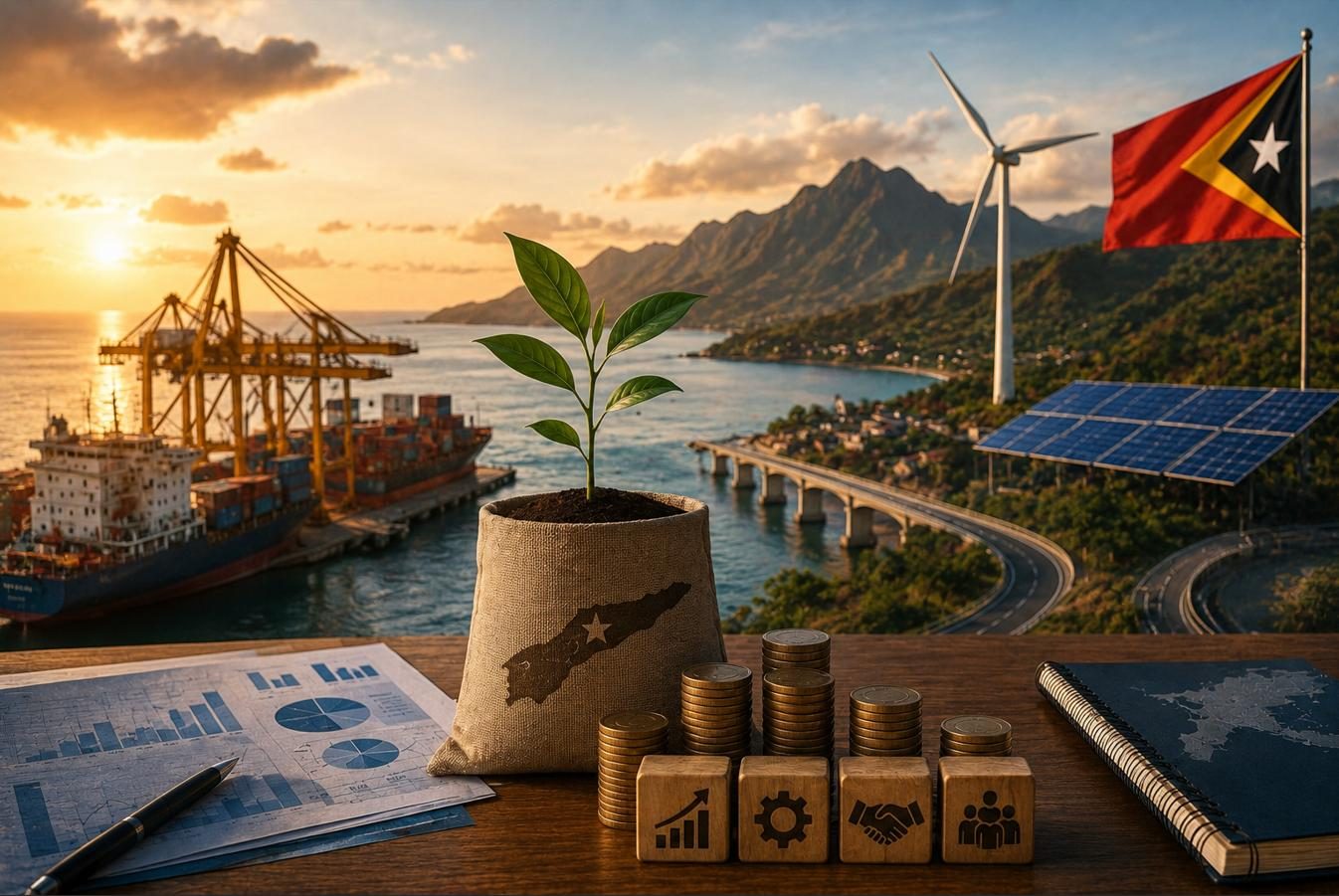
Timor-Leste has entered the most consequential stretch of its economic history holding credentials few young nations can match. On 26 October 2025 it was admitted as the eleventh member of ASEAN, and in 2024 it acceded to the World Trade Organization.[1] It operates in United States dollars, holds a sovereign wealth fund of more than US$18 billion,[2] and has sustained peaceful democratic transfers of power since the restoration of independence in 2002. Few countries of some 1.3 million people arrive at the regional table so well introduced.
Yet the arithmetic underneath is demanding. The state is financed overwhelmingly by a resource endowment that is winding down. Bayu-Undan, the offshore field whose revenues built the Petroleum Fund, ceased production in 2023. The national conversation has therefore turned to a single question: what pays for the state in 2035? The answer will be written in tax policy, tax administration and the investment climate, and the encouraging news is that most of the tools are already on the table.
How the state is financed
The Petroleum Fund, established in 2005 on international best practice, receives all petroleum revenue before any of it reaches the budget. Withdrawals are guided by an Estimated Sustainable Income benchmark of 3 per cent of total petroleum wealth, designed so that the fund can support spending indefinitely.[3] In practice, successive budgets have drawn above that benchmark for many years to meet pressing development needs, a path the IMF has repeatedly flagged as a risk to long-run fiscal sustainability, and with major production paused the fund is now the budget’s dominant source.[4] It stood at US$18.31 billion at the end of March 2026.[2]
The comparison the fund invites is Norway, and the resemblance is no accident. Timor-Leste built it in 2005 on the Norwegian model, with Norwegian and IMF assistance;[3] it taxes petroleum under a dedicated regime far heavier than the ordinary economy;[9] and in 2010 it became the first country in Asia certified compliant with the Extractive Industries Transparency Initiative.[10] Where the two stories part is not collection but spending discipline, and even that divergence has a respectable defence in a capital-scarce country whose roads, ports and clinics can plausibly out-earn global bond markets. The consequence is a test rather than a verdict: the drawings must buy things that earn more than the fund would have, and the domestic revenue base must be ready before the arithmetic tightens.
The scale of the state relative to the economy makes the point vividly. The consolidated 2026 budget, approved by the National Parliament in November 2025, is US$2.291 billion, close to the size of the entire non-oil economy.[5] Domestic taxation, by contrast, covers only a small share of it; the balance is met by transfers from the Fund. Coffee, the flagship non-oil export, together with the country’s other non-oil goods earns around US$21 million a year.[6] It matters enormously to rural incomes and to the national brand; it cannot carry a treasury.
None of this is cause for alarm. It is cause for sequencing. A fund of more than US$18 billion is not a crisis; it is time. The task is to use that time to build the revenue base and the investment platform that will outlast it.
A deliberately light tax system
Timor-Leste’s tax settings, consolidated in the 2008 Taxes and Duties Act, were designed for a post-conflict economy with a small formal sector and a tax administration still being built. The result is one of the lightest rate cards in the Asia-Pacific. Corporate income tax is a flat 10 per cent for most businesses, with petroleum contractors taxed under the separate and heavier regime noted above. Wage income tax is withheld at 10 per cent, applying only to monthly wages above US$500, so lower earnings fall outside it entirely.[7][8] A 5 per cent services tax applies to hotel, restaurant and telecommunications turnover above a threshold. Sales tax is 2.5 per cent on imports, with the domestic rate set at zero. Import duty is 5 per cent, supplemented by targeted excises on tobacco, alcohol, sugar, fuel and luxury vehicles. There is no value-added tax, no property tax, no stamp duty and no transfer tax, and the treaty network consists of a single agreement with Portugal.[7]
For its moment, the design was defensible. Its consequence today is equally clear: light rates produce light yield, and a state financed by petroleum could afford not to mind. That era is closing.
Raising revenue without deterring investment
The instinct that a small, open economy must remain tax-competitive is correct, and nothing that follows requires abandoning it. The reform logic is base first, rates later.
The centrepiece is the value-added tax. The 2026 General State Budget commits the Government to preparing for VAT introduction in 2027, with revenue expected to add around 1 per cent of GDP initially and to grow as the formal economy and regional trade deepen.[11] The case is structural rather than ideological. A VAT taxes consumption, not investment returns, so it raises revenue without penalising the capital formation the country needs. Its credit-invoice mechanics pull firms into the formal economy, because each business needs documentation from the one before it. And in an import-reliant economy, a large share of collection can be secured at the border from day one. A sensible registration threshold keeps market traders and micro-enterprises outside the net, and the existing services and sales taxes can be retired as the VAT arrives, so that businesses face one coherent system rather than accumulating layers.
Fairness deserves a direct answer rather than a footnote. The standard objection to consumption taxes is that they weigh heaviest on households that spend most of what they earn. In Timor-Leste’s setting the concern is real but manageable: a registration threshold keeps small traders outside the system, much of the subsistence economy stands outside the invoice chain altogether, and equity is delivered more efficiently through the spending side, where the state already runs substantial social transfer programmes, than by carving exemptions into the base. Nor is the present system the regressive caricature sometimes assumed; the wage tax exempts low monthly earnings entirely before its flat rate applies, so its average burden rises with income.[8] The sharpest fairness problem in the current settlement is in fact intergenerational. Financing today’s state by drawing down a finite fund passes the bill to future citizens, in a country with one of the youngest populations in the region. A broad domestic tax base is what makes the fiscal system fair not only across incomes but across generations.
The second lever is administration, and it is easily underrated. The same budget commits to modernising and digitising tax and customs systems.[12] In a narrow-base economy, a dollar invested in registration, electronic filing, audit capacity and customs modernisation returns more than a rate rise imposed on the few firms already complying. The excises already in place on tobacco, alcohol and sugar offer further headroom through indexation and enforcement, with public health gains alongside.
What should not change is the headline offer. A 10 per cent corporate rate is a genuine advantage for a frontier economy; the improvement is to surround it with certainty. Incentives published as a rules-based schedule, rather than negotiated case by case, cost less and reassure more. Over the longer term, as land titling matures, a modest recurrent property tax would give municipalities a stable base of their own. The direction throughout is the same: broaden what is taxed, digitise how it is collected, and leave the rates that investors see untouched.
What Singapore actually teaches
Small nations reaching for a development model reach naturally for Singapore, and rightly so. But the popular version of the story, that low taxes attracted the capital that built the metropolis, gets the sequence backwards. Singapore’s corporate tax rate stood at 40 per cent into the mid-1980s and was first cut only in 1987, reaching today’s 17 per cent as recently as 2010.[13] What Singapore sold investors from the beginning was not a rate. It was certainty: an empowered investment-promotion agency that could say yes quickly, contracts that were enforced, infrastructure delivered on schedule, an education system aligned to industry, and rules that did not shift with the political weather. The rate cuts came later, financed by a broad consumption base once the Goods and Services Tax arrived in 1994; that tax began at 3 per cent and stands at 9 per cent today, and it is precisely what allows enterprise and talent to be taxed lightly.[14]
Two implications follow for Timor-Leste. The first is diagnostic. At 10 per cent, its corporate rate is already below Singapore’s. If headline rates alone attracted investment, Dili would be crowded. They do not, which means the binding constraints lie elsewhere: land certainty, dispute resolution, reliable utilities, logistics and skills. That is where the investment agenda should concentrate, and it is notable that the current reform programme, spanning land titling, financial inclusion, insolvency and accounting standards, digital connectivity and airport upgrades, reads like precisely that list.[12] The second implication is fiscal. Singapore taxes enterprises lightly because it taxes consumption broadly. A Timorese VAT is not in tension with a low-tax investment offer; it is what makes the offer durable.
Timor-Leste also holds one advantage Singapore did not at the outset: an external anchor. ASEAN membership and WTO commitments now signal, and help to discipline, the country’s regulatory direction.[1] Each step of integration is a further assurance to investors that the rules are converging on regional norms.
Beyond petroleum and coffee
The petroleum story itself is not finished. The Greater Sunrise fields, discovered in 1974 and operated by Woodside with a 33.44 per cent interest alongside the national company TIMOR GAP as majority partner, have moved perceptibly after decades in which the framework around them remained unsettled; a maritime boundary treaty with Australia was concluded in 2019, and a joint concept study followed in 2024.[15] In November 2025 the Government and Woodside signed a cooperation agreement to mature a Timor-Leste-based liquefied natural gas concept,[16] and offshore survey work for the associated pipelines is mobilising from the third quarter of 2026.[17] If the project proceeds, it would be significant for employment, for the south coast and for national confidence.
The discipline lies in how to account for it. Revenue from any development would arrive only after years of construction, and it would be a second endowment of the same kind as the first: finite. The prudent posture is to treat Greater Sunrise as an extension of the runway rather than the destination, and to let the Petroleum Fund keep doing what it was designed to do, converting temporary receipts into permanent capability. The field’s half-century on the shelf carries its own lesson: a heavy government take and a credible one are compatible, but only together, because resource wealth becomes revenue only when investors can bank the terms.
Diversification, meanwhile, should follow the country’s real endowments. Tourism has a distinctive proposition in an unspoilt coastline, world-class diving and a new ASEAN profile. Coffee can climb the value chain from commodity green bean toward processing and specialty branding, with adjacent potential in spices and horticulture. Fisheries offer returns under proper licensing and surveillance. A young, multilingual population working across Tetum, Portuguese, English and Indonesian is an underused services asset. None of these will match petroleum’s peaks, and none needs to. Together with a broad consumption tax, they change the composition of what the state stands on.
The decade ahead
The elements of the answer already sit in official documents: a VAT prepared for 2027 and delivered on time; sustained investment in digital tax and customs administration; incentives codified rather than negotiated; land, insolvency and connectivity reforms carried through; and ASEAN integration used as a standing commitment device. The Petroleum Fund still holds more than US$18 billion. Managed as a bridge, that is enough time to build the far bank.
For investors and development partners, the reform window itself is the opportunity. Small states that get their institutions right punch far above their weight, and Singapore remains the region’s standing proof. Timor-Leste has spent two decades earning its seat at the table. The next decade is about financing it, and the work has visibly begun.
Sources
- Government of Timor-Leste / Ministry of Finance, General State Budget 2026 Report (stating accession to the WTO in 2024 and full ASEAN membership on 26 October 2025).
- Banco Central de Timor-Leste, Petroleum Fund key numbers / Public Finance Statistics (Petroleum Fund investment as of 31 March 2026: Total Fund = US$18.31 billion).
- International Forum of Sovereign Wealth Funds, Timor-Leste Petroleum Fund member profile (Fund established 2005 under Petroleum Fund Law No. 9/2005; all petroleum income enters the Fund before transfers; Estimated Sustainable Income set at 3% of Petroleum Wealth); and IMF, Building Monetary and Financial Systems, chapter 11 (Fund built on the Norwegian “oil fund” model with IMF and Norwegian technical assistance).
- International Monetary Fund, IMF Executive Board Concludes 2017 Article IV Consultation with Timor-Leste, Press Release No. 17/464 (significant frontloading of public investment and large Petroleum Fund withdrawals pose downside risks to fiscal sustainability).
- Government of Timor-Leste, National Parliament Approves 2026 State Budget (consolidated 2026 General State Budget of US$2.291 billion, approved 21 November 2025).
- Government of Timor-Leste / Ministry of Finance, General State Budget 2026 Report (non-oil exports of around US$21 million per year, mainly coffee).
- PwC, Worldwide Tax Summaries — Timor-Leste (corporate income tax 10%; services tax; sales tax on imports; import duty; excises; absence of VAT, property, stamp and transfer taxes; treaty with Portugal).
- Autoridade Tributária Timor-Leste, Wage Income Tax (resident wage income tax: 0% on the first US$500 of monthly wages, 10% above).
- Extractive Industries Transparency Initiative, Timor-Leste country page (petroleum activities taxed via profit oil, first tranche petroleum, royalties and corporate income tax under production-sharing contracts).
- U.S. Department of State, Investment Climate Statement — Timor-Leste (in July 2010 Timor-Leste became the third country in the world, and the first in Asia, certified compliant with the EITI).
- Government of Timor-Leste / Ministry of Finance, General State Budget 2026 Report (planned introduction of a Value Added Tax in 2027, expected to add around 1 per cent of GDP initially).
- Government of Timor-Leste, 2026 General State Budget Approved in General Terms (structural reforms in land titling, financial inclusion, solvency and accounting standards, digital connectivity and airport infrastructure; modernisation and digitisation of public financial management, tax and customs).
- Wikipedia, Goods and Services Tax (Singapore) and Inland Revenue Authority of Singapore history (corporate income tax stood at 40% prior to 1986; first reduced to 33% in 1987; reached 17% by 2010), corroborated by Trading Economics, Singapore Corporate Tax Rate (record low of 17% reached 2010).
- Wikipedia, Goods and Services Tax (Singapore) (GST implemented at 3% on 1 April 1994; current standard rate 9%).
- Woodside Energy, Greater Sunrise project page (fields located approximately 150 km south of Timor-Leste; Woodside operator holding 33.44%; 2019 maritime boundary treaty; 2024 concept study; first discovery in 1974 corroborated by Energy News Bulletin).
- Government of Timor-Leste, New Era of Cooperation Dawns for Greater Sunrise (November 2025 cooperation agreement between the Ministry of Petroleum and Mineral Resources and Woodside to mature a Timor-Leste LNG concept).
- Fugro, Fugro signed contract for Greater Sunrise and Bayu Undan pipeline survey programme in Timor-Leste (project mobilisation from Q3 2026, offshore survey operations from Q4 2026); and Tatoli, MPRM signs Major Offshore Survey Contract for the Greater Sunrise Gas Export Pipeline, 17 July 2026.
Dave Ananth, Honorary Consul of Timor-Leste, Auckland, New Zealand.
Research assistance by Lucas Zhang, Chancellor’s Award recipient and Dalyell Scholar at the University of Sydney.